-
Shop
- Advanced Technologies
- AI Career Advantage Collection
- AI Skills
- AI Skills for Creators & Freelancers
- AI Client Management
- AI Ethics
- AI Mindset
- AI Tools & Prompts
- AI Writing & Content Creation
- Audio, Voice & Music
- Design & Visual Creation
- Email, Messaging & Communication
- Freelancing & Business
- Marketing, Ads & Conversion
- Productivity, Workflow & Automation
- SEO & Search Optimization
- Social Media Content & Growth
- Strategy, Planning & Analytics
- Video Creation & Editing
- AI Skills Mastery 2026 Collection
- Beauty Guides Collection
- Car Accessories
- Confidence
- Dating & Social Skills
- Digital Resources
- Beauty
- Budgeting & Saving
- Car Buying & Ownership
- Cozy Feast Collection
- Electronics & Technology
- Emotional Intelligence
- Entrepreneurship & Business Growth
- Financial Education
- Financial Independence
- Financial Mindset & Psychology
- Goal Setting
- Hobbies
- Home Styling & Organization
- Leadership
- Mindfulness
- Mindset
- Motivation
- Online Business
- Parenting & Child Development
- Personal Style & Fashion
- Pet Lifestyle & Wellness
- Positive Thinking
- Productivity
- Self Confidence
- Sleep Improvement
- Smart Life with AI
- Stress Management & Relaxation
- Travel Planning
- Wellness
- Yoga & Fitness
- Yoga & Mind-Body Practices
- Education & Learning
- Family & Parenting
- Fashion
- Fashion Accessories
- Furniture
- Gadgets
- Health & Beauty
- Health & Wellness
- Home & Garden
- Home Supplies
- Kids & Babies
- Kitchen
- Legend Footwear Brands Collection
- Lighting
- Luxury Brands Collection
- Nike
- Online Business for Beginners
- Patio, Lawn & Garden
- Personal Growth
- Pet Care
- Pet Supplies
- Pets
- Smart Amazon Shopping
- Smart Home Living Guides
- Sport & Outdoors
- Stress Relief & Relaxation
- Super Deals
- Travel
- Travel & Adventure
- Wealth
- Wealth Building
- Popular
- Best deals



Product Description
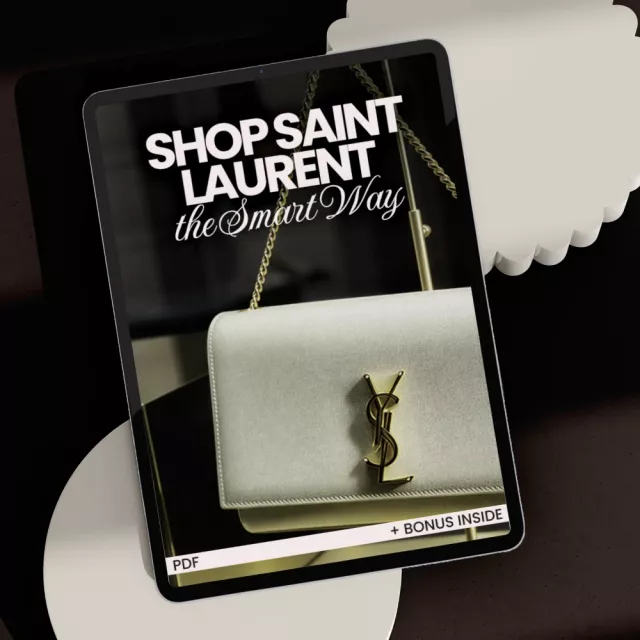
Unlock the Secrets of Saint Laurent Authenticity with the Ultimate Guide
Discover the world of luxury fashion and protect yourself from the risks of counterfeit products with the Luxury Verified: Saint Laurent Brand Guide. This comprehensive eBook is designed to be your ultimate resource for understanding the intricacies of authenticating Saint Laurent items. Whether you’re a collector, fashion enthusiast, or someone who wants to confidently shop for Saint Laurent, this guide is your go-to tool for ensuring every piece you own or purchase is genuine. Learn how to spot fakes and verify authenticity with expert insights and detailed examples.
Inside this guide, you’ll find:
- Introduction to Saint Laurent and Brand Authentication – Explore the legacy of Saint Laurent and why authenticity matters in today’s luxury market.
- Understanding Saint Laurent Signatures and Logos – Dive into the evolution of the Saint Laurent logo and how to recognize classic fonts and engravings.
- Materials, Stitching, and Craftsmanship – Learn how to identify real leather quality, stitching patterns, and hardware finishes that reveal authenticity.
- Labels, Serial Numbers, and Tags – Master the art of reading tags, serial numbers, and font placement for an accurate authentication check.
- Packaging, Dust Bags, and Receipts – Learn what to look for in Saint Laurent packaging and receipts to confirm authenticity.
- Spotting Fakes Online and in Stores – Arm yourself with knowledge to recognize red flags in online listings and store checks.
- Leveraging AI Tools for Saint Laurent Authentication – Discover how AI-powered image analysis and prompts can support your authentication efforts.
- Final Tips and Building Your Saint Laurent Knowledge – Keep your collection in top shape and learn from your experiences to build a deeper understanding of Saint Laurent craftsmanship.
Who is this guide for?
This digital product is perfect for fashion enthusiasts, collectors, and anyone looking to authenticate their Saint Laurent items with confidence. Whether you’re purchasing new or pre-owned, this guide helps you avoid costly mistakes and ensures that you are investing in genuine, luxury products.
What makes this guide different?
Unlike other general guides, the Saint Laurent Brand Guide focuses specifically on the intricacies of this iconic brand, with a detailed breakdown of its unique logos, materials, stitching, and packaging. Plus, you’ll get access to practical exercises and cutting-edge AI tools to assist in your authentication process.
Why wait? Protect your luxury purchases today!
Download the Luxury Verified: Saint Laurent Brand Guide now and start confidently spotting authentic Saint Laurent items. Ensure your collection is as luxurious as it is genuine!
Shipping & Delivery
SHIPPING
We are proud to offer international shipping services that currently operate in over 200 countries and islands world wide. Nothing means more to us than bringing our customers great value and service. We will continue to grow to meet the needs of all our customers, delivering a service beyond all expectation anywhere in the world.
Do you ship worldwide?
Yes. We provide free shipping to over 200 countries around the world. However, there are some locations we are unable to ship to. If you happen to be located in one of those countries we will contact you.
What about customs?
We are not responsible for any custom fees once the items have been shipped. By purchasing our products, you consent that one or more packages may be shipped to you and may get custom fees when they arrive to your country.
How long does shipping take?
Shipping time varies by location. These are our estimates:| Location | *Estimated Shipping Time |
|---|---|
| United States | 5-20 Business days |
| Canada, Europe | 5-20 Business days |
| Australia, New Zealand | 5-20 Business days |
| Central & South America | 5-25 Business days |
| Asia | 5-20 Business days |
| Africa | 5-25 Business days |
Do you provide tracking information?
Yes, you will receive an email once your order ships that contains your tracking information. If you haven’t received tracking info within 5 days, please contact us.
My tracking says “no information available at the moment”.
For some shipping companies, it takes 2-5 business days for the tracking information to update on the system. If your order was placed more than 5 business days ago and there is still no information on your tracking number, please contact us.
Will my items be sent in one package?
For logistical reasons, items in the same purchase will sometimes be sent in separate packages, even if you've specified combined shipping.
If you have any other questions, please contact us and we will do our best to help you out.
RETURNS
Order cancellation
All orders can be cancelled until they are shipped. If your order has been paid and you need to make a change or cancel an order, you must contact us within 12 hours. Once the packaging and shipping process has started, it can no longer be cancelled.
Refunds
Your satisfaction is our #1 priority. Therefore, you can request a refund or reshipment for ordered products if:
- If you did not receive the product within the guaranteed time (45 days not including 1-3 day processing) you can request a refund or a reshipment.
- If you received the wrong item you can request a refund or a reshipment.
- If you do not want the product you’ve received you may request a refund but you must return the item at your expense and the item must be unused.
We do not issue the refund if:
- Your order did not arrive due to factors within your control (i.e. providing the wrong shipping address)
- Your order did not arrive due to exceptional circumstances outside the control of letsshopcc.com (i.e. not cleared by customs, delayed by a natural disaster).
- Other exceptional circumstances outside the control of letsshopcc.com.
*You can submit refund requests within 15 days after the guaranteed period for delivery (45 days) has expired. You can do it by sending a message on Contact Us page
If you are approved for a refund, then your refund will be processed, and a credit will automatically be applied to your credit card or original method of payment, within 14 days.
Exchanges
If for any reason you would like to exchange your product, perhaps for a different size in clothing, you must contact us first and we will guide you through the steps.
Please do not send your purchase back to us unless we authorise you to do so.
Refunds & Returns
Order cancellation
All orders can be cancelled until they are shipped. If your order has been paid and you need to make a change or cancel an order, you must contact us within 12 hours. Once the packaging and shipping process has started, it can no longer be cancelled.
Refunds
Your satisfaction is our #1 priority. Therefore, you can request a refund or reshipment for ordered products if:
- If you did not receive the product within the guaranteed time( 45 days not including 2-5 day processing) you can request a refund or a reshipment.
- If you received the wrong item you can request a refund or a reshipment.
- If you do not want the product you’ve received you may request a refund but you must return the item at your expense and the item must be unused.
We do not issue the refund if:
- Your order did not arrive due to factors within your control (i.e. providing the wrong shipping address)
- Your order did not arrive due to exceptional circumstances outside the control of letsshopcc.com (i.e. not cleared by customs, delayed by a natural disaster).
- Other exceptional circumstances outside the control of
*You can submit refund requests within 15 days after the guaranteed period for delivery (45 days) has expired. You can do it by sending a message on Contact Us page
If you are approved for a refund, then your refund will be processed, and a credit will automatically be applied to your credit card or original method of payment, within 14 days.
Exchanges
If for any reason you would like to exchange your product, perhaps for a different size in clothing. You must contact us first and we will guide you through the steps.
Please do not send your purchase back to us unless we authorise you to do so.
Customer Reviews
See why hundreds love this product and trust us
Based on 43 reviews
Write a Review
We Think You’ll Love
Top picks just for you
















I almost dropped $1,200 on a Saint Laurent wallet from a resale site last month. After reading the serial number verification section, I checked the tag on the listing photos and immediately noticed the embossing depth was off — shallow and slightly smudged compared to the examples described here. I walked away from that purchase and found an authenticated one instead. This guide literally paid for itself before I even finished reading it.
The hardware comparison table is worth bookmarking permanently.
Finally an authentication guide that treats AI as a supplement rather than a silver bullet. The balance between tech tools and hands-on inspection is exactly right.
Thorough, well-organized, and immediately practical 🔥
The stitching section changed how I shop. I never thought to check interior seams — I was only looking at the outside. The case study about the shoulder bag with flawless exterior stitching but uneven interior work was a real eye-opener. Now I flip every bag inside out before considering a purchase.
Solid reference for anyone buying secondhand SL pieces.
The logo evolution timeline was something I hadn't seen broken down this clearly anywhere else. Knowing that a product labeled YSL should match its production era versus the newer Saint Laurent Paris branding is such a simple but powerful authentication check.
Wish it included more photos alongside the text descriptions. The written comparisons are strong, but visual side-by-sides would make the leather texture and embossing sections even more useful for beginners.
Clean writing, zero filler — respect for my time.
I run a consignment shop and this has become required reading for every new hire. The systematic checklist approach — logo, stitching, serial number, packaging — gives my team a repeatable process instead of relying on gut instinct. We've caught three fakes in the first two weeks since implementing it.
The packaging section surprised me the most. I never thought to check tissue paper or dust bag drawstring quality, but those small details have turned out to be some of the easiest tells.
👜✨⭐👌
Read it cover to cover on a Sunday and felt confident enough to authenticate a bag by Monday.
The red flags section for online listings should be pinned in every resale group on the internet. Low-res photos hiding logo details, missing interior tag shots, prices that are suspiciously low — everything described here matches patterns I've seen but never had the vocabulary to articulate.
Good starting point, though experienced collectors might find some sections cover familiar territory. The AI integration angle is the freshest part and worth reading for that alone.
The font consistency breakdown is incredibly specific and useful.
I've been collecting SL pieces for six years and still learned new details from the hardware and metal finishes section. The point about checking engraving depth under bright light caught a flaw I'd been overlooking on a belt I bought last year. Turns out the engraving was shallow and uneven — exactly the counterfeit marker described here. Returned it within the week.
Practical, structured, and easy to reference on the go.
The case study about the wallet buyer who noticed shallow engraving and synthetic leather scent resonated — I had almost the exact same experience last spring. Having a framework like this would have saved me the headache of filing a dispute.
I appreciated that the AI limitations section is included alongside the AI tools. Most guides either oversell the technology or ignore it completely. This one is measured and realistic about where AI helps and where your own hands and eyes still matter.
Covers everything from tags to dust bags — nothing left out.
The receipt verification tips caught me off guard. I'd been trusting receipts at face value, and learning that counterfeiters forge those too — and that you should cross-check the store name against authorized retailers — was a wake-up call. Simple step, huge payoff.
Before this guide, I was buying SL accessories based on vibes and price. After working through the exercises, I developed an actual inspection routine: logo check, stitch count, serial number verification, packaging review. My very first time applying it, I spotted uneven font spacing on a bag clasp that I would have completely missed a month earlier. The seller refunded me without argument once I pointed it out with specifics. Having the language to describe what's wrong is as valuable as seeing it.
❤️🔥👏
Tight, well-paced, and respects the reader's intelligence.
The leather texture comparison — matte vs glossy, natural grain irregularities vs printed uniformity — was the section that clicked for me. I can now feel the difference in seconds just by running my thumb across the surface 👌
Solid guide but the AI prompt examples feel more like teasers than full workflows. Would love a follow-up that goes deeper into setting up an image comparison pipeline for authentication at scale.
The collection maintenance tips at the end were an unexpected bonus. Proper storage and conditioning advice extends the life of authentic pieces and protects their resale value.
Every reseller needs this in their toolkit.
I teach a workshop on luxury authentication and this guide covers the SL-specific nuances that broader authentication courses gloss over. The hidden stitching detail — where luxury seams are deliberately tucked inside folds and counterfeits skip that step — is the kind of insight that separates casual knowledge from real expertise. I've added the exercises to my curriculum.
Clear, practical, and no wasted pages.
Would be stronger with more visual examples. The text descriptions of authentic vs counterfeit details are precise, but pairing them with annotated images would make the guide more accessible to visual learners.
The serial number format breakdown is the kind of specific detail that separates a useful guide from a generic one.
I bought a Saint Laurent bag from a consignment shop two years ago feeling uneasy the whole time. After reading this, I went back and inspected it using the guide's checklist — logo alignment, tag embossing, serial number format, hardware weight. Everything checked out. The peace of mind alone was worth it, and now I shop with actual confidence instead of anxiety.
Smart balance of theory and hands-on exercises throughout.
The part about not dismissing an item just because the box is worn was a good corrective. I've passed on authentic pieces before because the packaging looked rough, not realizing that storage wear doesn't equal fake.
Some overlap between sections — the stitching and hardware points come up in multiple chapters. Tightening that would make it an even sharper read. Still very useful overall.
Shared this with my entire resale community within an hour of finishing it 🔥
The in-store check protocol is something I now do automatically — leather smell, stitch tension, logo symmetry, serial verification. Takes under five minutes and has already saved me twice.
🖤✨👜⭐👌🔥
Methodical without being dry — enjoyed reading it as much as using it.
The guide's strongest move is framing authentication as a skill you build over time rather than a checklist you run once. The emphasis on documenting your observations and comparing regularly turned me from a nervous buyer into someone who actually enjoys the inspection process.
Concise, specific, and immediately applicable to my next purchase.