-
Shop
- Advanced Technologies
- AI Career Advantage Collection
- AI Skills
- AI Skills for Creators & Freelancers
- AI Client Management
- AI Ethics
- AI Mindset
- AI Tools & Prompts
- AI Writing & Content Creation
- Audio, Voice & Music
- Design & Visual Creation
- Email, Messaging & Communication
- Freelancing & Business
- Marketing, Ads & Conversion
- Productivity, Workflow & Automation
- SEO & Search Optimization
- Social Media Content & Growth
- Strategy, Planning & Analytics
- Video Creation & Editing
- AI Skills Mastery 2026 Collection
- Beauty Guides Collection
- Car Accessories
- Confidence
- Dating & Social Skills
- Digital Resources
- Beauty
- Budgeting & Saving
- Car Buying & Ownership
- Cozy Feast Collection
- Electronics & Technology
- Emotional Intelligence
- Entrepreneurship & Business Growth
- Financial Education
- Financial Independence
- Financial Mindset & Psychology
- Goal Setting
- Hobbies
- Home Styling & Organization
- Leadership
- Mindfulness
- Mindset
- Motivation
- Online Business
- Parenting & Child Development
- Personal Style & Fashion
- Pet Lifestyle & Wellness
- Positive Thinking
- Productivity
- Self Confidence
- Sleep Improvement
- Smart Life with AI
- Stress Management & Relaxation
- Travel Planning
- Wellness
- Yoga & Fitness
- Yoga & Mind-Body Practices
- Education & Learning
- Family & Parenting
- Fashion
- Fashion Accessories
- Furniture
- Gadgets
- Health & Beauty
- Health & Wellness
- Home & Garden
- Home Supplies
- Kids & Babies
- Kitchen
- Legend Footwear Brands Collection
- Lighting
- Luxury Brands Collection
- Nike
- Online Business for Beginners
- Patio, Lawn & Garden
- Personal Growth
- Pet Care
- Pet Supplies
- Pets
- Smart Amazon Shopping
- Smart Home Living Guides
- Sport & Outdoors
- Stress Relief & Relaxation
- Super Deals
- Travel
- Travel & Adventure
- Wealth
- Wealth Building
- Popular
- Best deals

Product Description
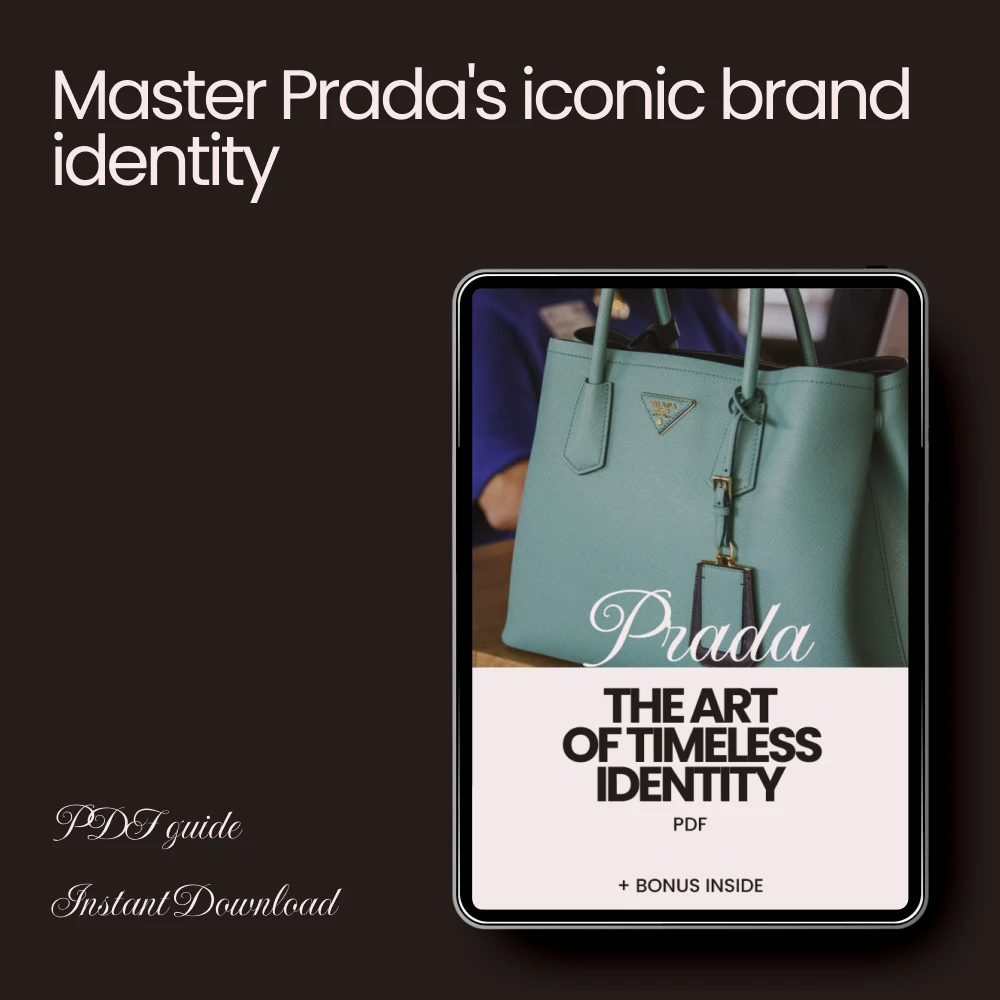
Discover the Secrets Behind Prada’s Timeless Brand Identity
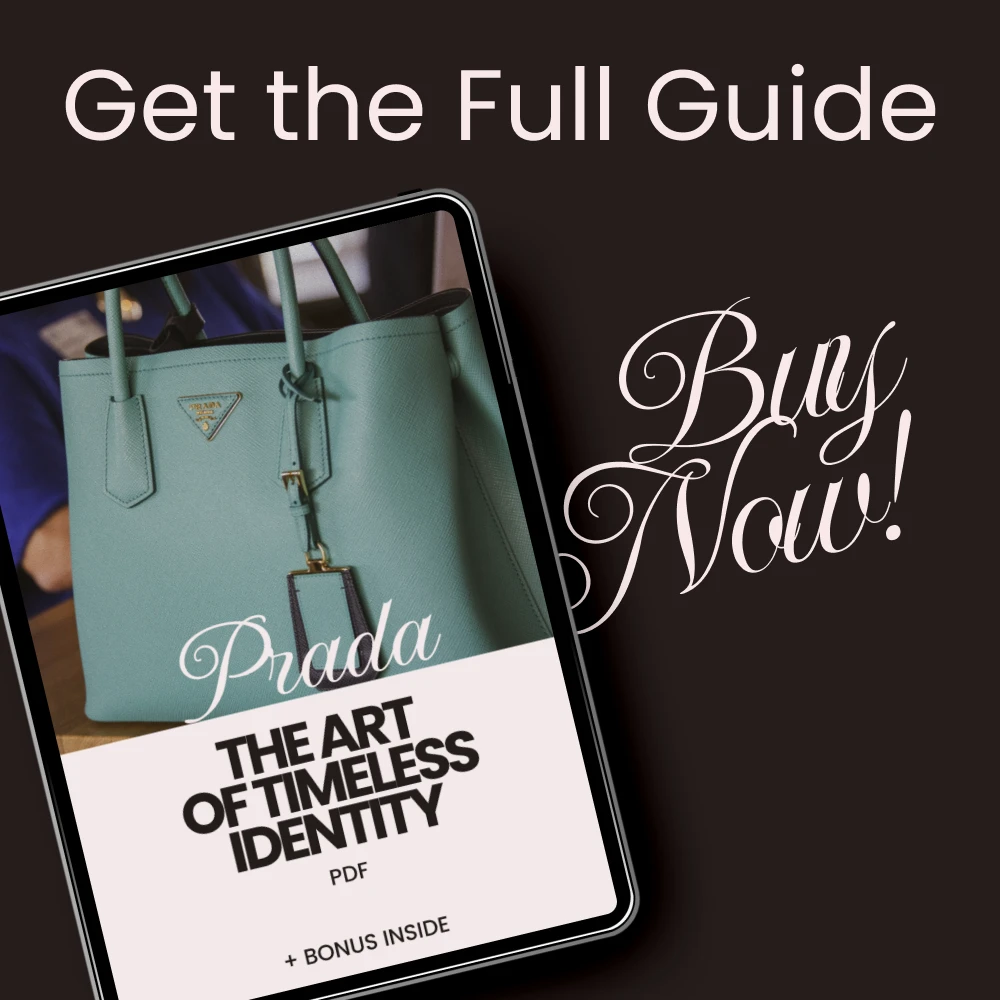
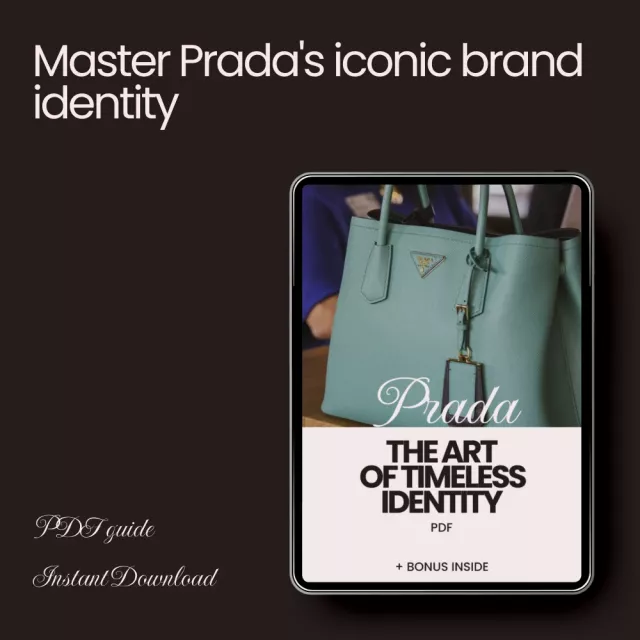
Unlock the world of one of the most iconic luxury fashion brands with Prada: The Art of Timeless Identity, a digital guide that delves into the heart of Prada’s world-renowned brand identity. This eBook reveals the key elements that have made Prada a symbol of sophistication, luxury, and innovation. Whether you’re a fashion enthusiast, entrepreneur, or brand strategist, this guide will give you valuable insights into how Prada has crafted a lasting legacy that resonates across generations.
Inside, you’ll explore the elements that define Prada’s unique identity, from its minimalist yet bold aesthetic to its exclusive marketing tactics. This eBook goes beyond just a look at the brand’s visual identity — it also offers a deep dive into its storytelling, product launches, and consumer experience strategies. Through detailed case studies and practical exercises, you’ll learn not just about Prada’s successes, but how to apply these lessons to build your own luxury brand identity.
Key Features
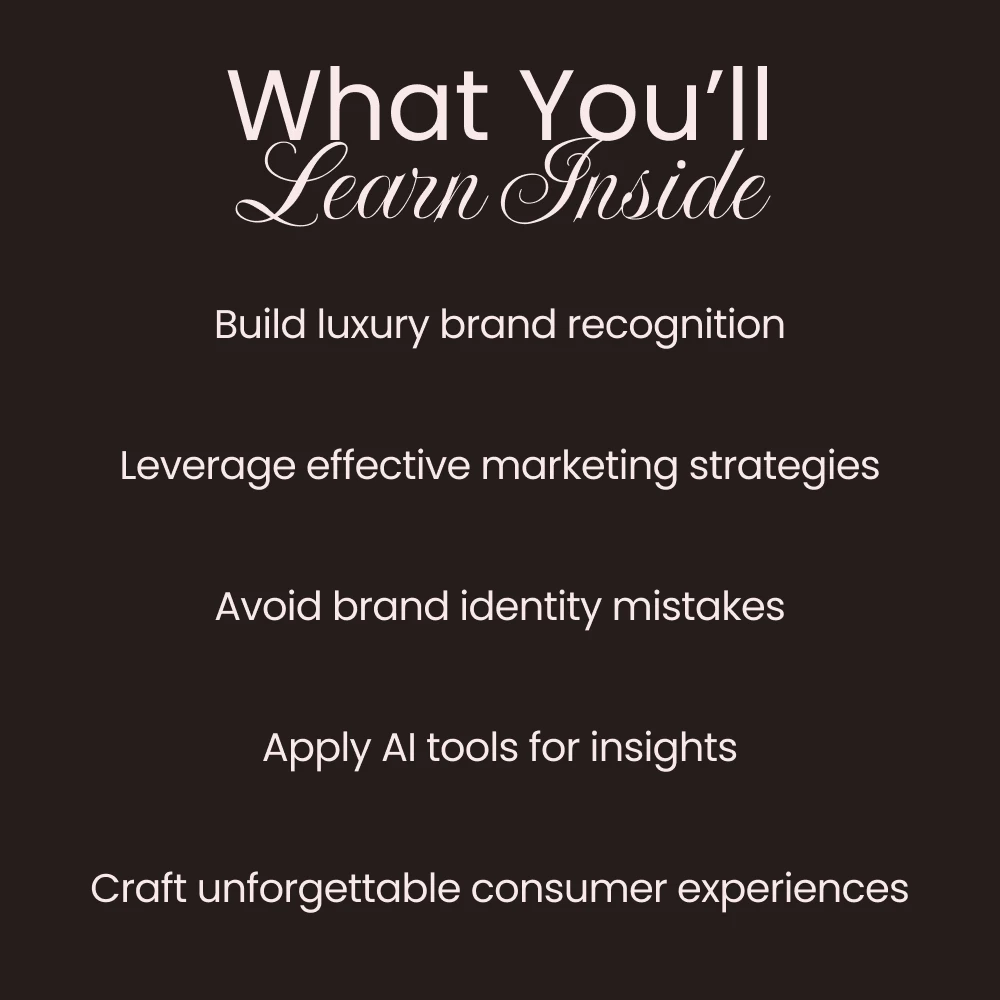
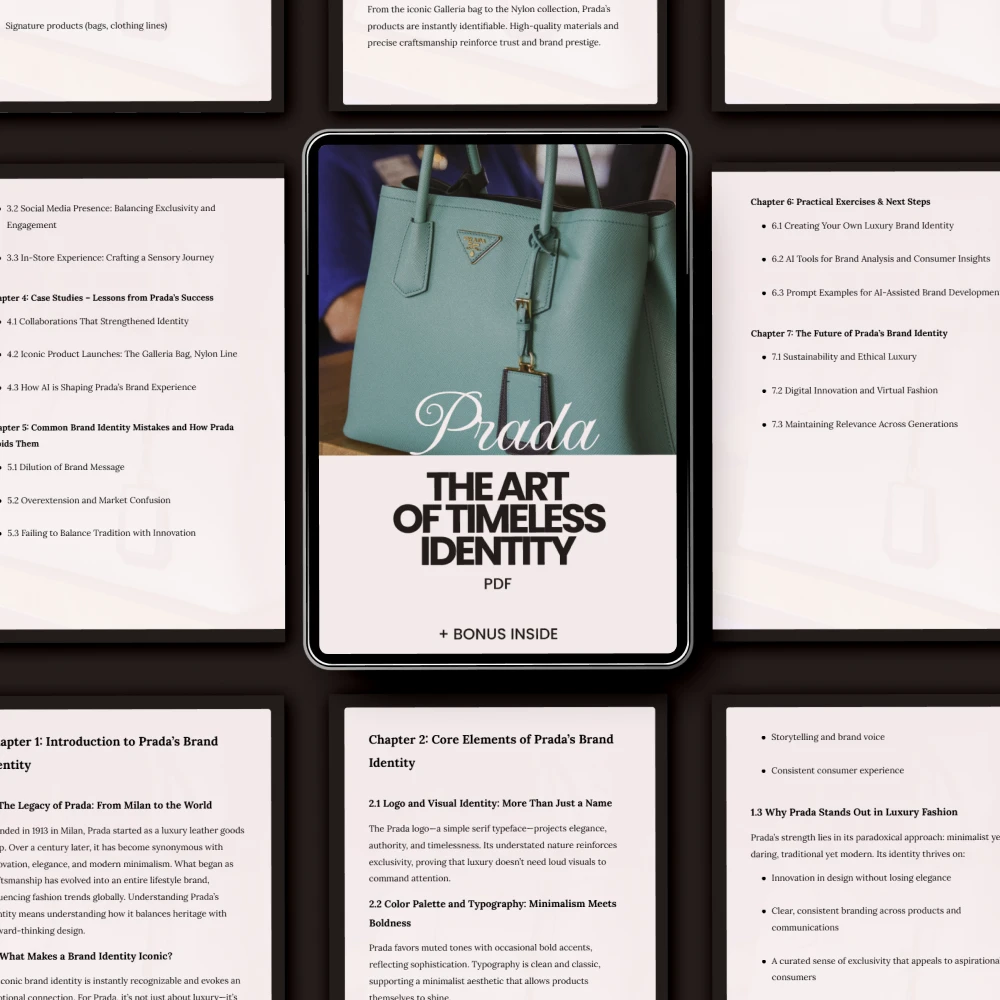
- Introduction to Prada’s Brand Identity – Learn the history and core principles that shaped Prada’s global success.
- Core Elements of Prada’s Identity – Explore how Prada’s logo, color palette, typography, and signature products create instant recognition.
- Marketing & Consumer Experience – Discover Prada’s powerful advertising campaigns, social media presence, and exclusive in-store experiences.
- Case Studies – Gain insights from Prada’s collaborations, product launches, and use of AI in shaping their brand.
- Brand Identity Mistakes to Avoid – Learn from Prada’s approach to staying authentic and avoiding common pitfalls in brand messaging.
- Practical Exercises – Apply key lessons to your own brand with actionable exercises and AI-assisted tools.
- The Future of Prada’s Brand Identity – Explore Prada’s sustainability efforts and digital innovations shaping the future of luxury fashion.
Practical Benefits
- Build Your Own Luxury Brand – Learn how to create a distinctive brand identity using Prada’s methods.
- Leverage AI Tools – Gain insights into cutting-edge tools to analyze and refine your brand’s identity.
- Avoid Brand Identity Pitfalls – Ensure that your brand’s message stays strong and clear without becoming diluted.
- Gain Real-World Insights – Use case studies and exercises to understand how Prada’s approach can be applied to your business or passion project.
Ready to take your brand to the next level? Download Prada: The Art of Timeless Identity today and start mastering the art of building an unforgettable luxury brand. Whether you’re crafting a new brand or refining an existing one, this guide will provide you with the tools, insights, and inspiration you need to succeed.
Shipping & Delivery
SHIPPING
We are proud to offer international shipping services that currently operate in over 200 countries and islands world wide. Nothing means more to us than bringing our customers great value and service. We will continue to grow to meet the needs of all our customers, delivering a service beyond all expectation anywhere in the world.
Do you ship worldwide?
Yes. We provide free shipping to over 200 countries around the world. However, there are some locations we are unable to ship to. If you happen to be located in one of those countries we will contact you.
What about customs?
We are not responsible for any custom fees once the items have been shipped. By purchasing our products, you consent that one or more packages may be shipped to you and may get custom fees when they arrive to your country.
How long does shipping take?
Shipping time varies by location. These are our estimates:| Location | *Estimated Shipping Time |
|---|---|
| United States | 5-20 Business days |
| Canada, Europe | 5-20 Business days |
| Australia, New Zealand | 5-20 Business days |
| Central & South America | 5-25 Business days |
| Asia | 5-20 Business days |
| Africa | 5-25 Business days |
Do you provide tracking information?
Yes, you will receive an email once your order ships that contains your tracking information. If you haven’t received tracking info within 5 days, please contact us.
My tracking says “no information available at the moment”.
For some shipping companies, it takes 2-5 business days for the tracking information to update on the system. If your order was placed more than 5 business days ago and there is still no information on your tracking number, please contact us.
Will my items be sent in one package?
For logistical reasons, items in the same purchase will sometimes be sent in separate packages, even if you've specified combined shipping.
If you have any other questions, please contact us and we will do our best to help you out.
RETURNS
Order cancellation
All orders can be cancelled until they are shipped. If your order has been paid and you need to make a change or cancel an order, you must contact us within 12 hours. Once the packaging and shipping process has started, it can no longer be cancelled.
Refunds
Your satisfaction is our #1 priority. Therefore, you can request a refund or reshipment for ordered products if:
- If you did not receive the product within the guaranteed time (45 days not including 1-3 day processing) you can request a refund or a reshipment.
- If you received the wrong item you can request a refund or a reshipment.
- If you do not want the product you’ve received you may request a refund but you must return the item at your expense and the item must be unused.
We do not issue the refund if:
- Your order did not arrive due to factors within your control (i.e. providing the wrong shipping address)
- Your order did not arrive due to exceptional circumstances outside the control of letsshopcc.com (i.e. not cleared by customs, delayed by a natural disaster).
- Other exceptional circumstances outside the control of letsshopcc.com.
*You can submit refund requests within 15 days after the guaranteed period for delivery (45 days) has expired. You can do it by sending a message on Contact Us page
If you are approved for a refund, then your refund will be processed, and a credit will automatically be applied to your credit card or original method of payment, within 14 days.
Exchanges
If for any reason you would like to exchange your product, perhaps for a different size in clothing, you must contact us first and we will guide you through the steps.
Please do not send your purchase back to us unless we authorise you to do so.
Refunds & Returns
Order cancellation
All orders can be cancelled until they are shipped. If your order has been paid and you need to make a change or cancel an order, you must contact us within 12 hours. Once the packaging and shipping process has started, it can no longer be cancelled.
Refunds
Your satisfaction is our #1 priority. Therefore, you can request a refund or reshipment for ordered products if:
- If you did not receive the product within the guaranteed time( 45 days not including 2-5 day processing) you can request a refund or a reshipment.
- If you received the wrong item you can request a refund or a reshipment.
- If you do not want the product you’ve received you may request a refund but you must return the item at your expense and the item must be unused.
We do not issue the refund if:
- Your order did not arrive due to factors within your control (i.e. providing the wrong shipping address)
- Your order did not arrive due to exceptional circumstances outside the control of letsshopcc.com (i.e. not cleared by customs, delayed by a natural disaster).
- Other exceptional circumstances outside the control of
*You can submit refund requests within 15 days after the guaranteed period for delivery (45 days) has expired. You can do it by sending a message on Contact Us page
If you are approved for a refund, then your refund will be processed, and a credit will automatically be applied to your credit card or original method of payment, within 14 days.
Exchanges
If for any reason you would like to exchange your product, perhaps for a different size in clothing. You must contact us first and we will guide you through the steps.
Please do not send your purchase back to us unless we authorise you to do so.
Customer Reviews
See why hundreds love this product and trust us
Based on 17 reviews
Write a Review
We Think You’ll Love
Top picks just for you













The Brand Identity Map exercise is the most immediately applicable tool in here.
I've studied luxury brand theory for years and this guide does something most academic texts fail at — it makes the logic of Prada's identity decisions feel inevitable rather than arbitrary. The Nylon Backpack origin story is used as a case study in how a single material choice can simultaneously challenge luxury conventions and reinforce them. The collaboration analysis, particularly Prada x Adidas, unpacks exactly why some partnerships work and others dilute — it's the brand alignment question, does this extend the narrative or contradict it. The brand identity audit framework in chapter five is something I now run quarterly on every client account. The customer journey mapping exercise rounds it out practically, which is rare in a guide this focused on theory.
Clarity beats quantity — three words that changed how I think about branding.
The section on Prada's in-store sensory design — minimalist layouts, lighting, staff trained in subtlety — reframed how I think about physical retail for my own small brand. Every touchpoint is identity, not just the product. Once I started mapping my own customer journey from that angle, the gaps became obvious.
What landed hardest was the point that Prada's campaigns feel like curated art experiences rather than advertisements 🎨 That's not a stylistic accident — it's a deliberate strategy to create cultural relevance rather than just product awareness. The exercise where you pick one Prada ad and map its colors, composition, and emotional impact is deceptively simple and genuinely useful for anyone trying to understand why luxury messaging works the way it does.
Strong foundation on visual identity and brand voice — would have liked more on competitor differentiation.
The brand dilution section is the sharpest part of the guide. Selective collaborations, focused product lines, and the brand alignment checklist — does this reinforce our story or contradict it — should be printed and taped above every marketing team's whiteboard. Prada's ability to expand without losing itself is the actual case study worth reading closely.
🏛️✨💼
The Nylon Backpack case study alone reframes what luxury materials can communicate.
The guide covers the strategic core of Prada's identity well — visual consistency, storytelling over product push, the scarcity-as-prestige logic. The Re-Nylon sustainability section is a genuinely important inclusion, since ethical practices as brand prestige rather than just compliance is an argument that doesn't get made clearly enough in most branding content. My one hesitation is that the social media section stays fairly high-level and could go deeper on how Prada actually navigates the tension between desirability and overexposure on platforms that reward volume.
Prada's paradox — minimalist yet daring, traditional yet modern — is finally explained without contradicting itself.
I run a small jewelry label that has been struggling with a very specific problem: we have a clear aesthetic but no framework for deciding what fits it and what doesn't. Every new product decision felt like a guess. I came to this guide after a failed collection launch that received genuinely positive feedback on the pieces individually but confused our existing customers as a group. Reading about how Prada avoids overextension — launching slowly, ensuring every product has a clear purpose within the identity, using limited editions to control desirability rather than scaling volume — crystallized exactly what went wrong for us. We'd chased a trend that was adjacent to our voice but not inside it. The brand alignment checklist in chapter five is now a standing item in our pre-production review. I also completed the four-step brand identity exercise in chapter six, writing our manifesto for the first time after three years of operating without one. The result was two paragraphs, but they've already prevented two questionable decisions that would have made the confusion worse. The Re-Nylon sustainability discussion was unexpectedly motivating — framing ethical sourcing as a prestige signal rather than a cost center reordered how I pitch our materials story to stockists. This guide is more useful as a strategic lens than a tactical checklist, but for where I was stuck, that's exactly what I needed.
The Galleria Bag product identity exercise is something I'm actively using with clients.
The insights here are well-organized and the AI prompt examples are a useful addition, particularly the campaign analysis one. What keeps this from being truly standout is that the AI sections read more like a list of possibilities than a demonstration of real integration — trend prediction, sentiment analysis, and AR try-ons are each mentioned once without showing how they connect into a coherent brand strategy. The fashion and branding content earns its strengths, but the tech layer needed another pass.
🔺🖤💎
The final chapter on maintaining relevance across generations is where this guide earns its depth 🌐 Blending timeless product designs with experimental collections, collaborating with contemporary artists without chasing trends, exploring digital channels without compromising prestige — these aren't platitudes, they're strategic constraints that define what Prada actually does. The actionable exercise at the end, identifying your core heritage, mapping relevant emerging trends, and finding the overlap, is the most honest brand-future framework I've seen condensed into three steps. The conclusion's point that luxury branding is not static but that the brands that endure combine timelessness with forward-thinking vision is the through-line the whole guide builds toward.
The brand manifesto exercise prompted me to write something I'd avoided for two years — worth it for that alone 📝 The guide's argument that luxury thrives on understatement over flashy promotion is made consistently from chapter one through the campaign analysis and into the digital innovation section. Nothing contradicts itself.